

Why Hotel Rankings Are Broken (And What I’m Building Instead)

Building Tripvento, a B2B travel API that matches hotels to traveler intent using PostGIS, semantic AI, and 14 traveler personas. Previously worked on ranking systems at U.S. News & World Report. Head TA at Georgia Tech's Graduate Intro to OS course. Writing about geospatial engineering, Django at scale, and building travel tech infrastructure.

I worked on the travel ranking team at U.S. News & World Report — Best Hotels, Best Destinations, Best Cruises. The lists that millions of people used to decide where to go and where to stay. Say what you want about rankings, but when you get the methodology right, they work. People trust them because the signals behind them are transparent and defensible.
Then I started paying attention to how the travel industry ranks hotels.
It’s embarrassing.
The problem nobody talks about
Go to any major booking site right now and search for a hotel. What do you get? A list sorted by some combination of price, star rating, and review score. Maybe a “recommended” badge that nobody can explain. That’s the entire ranking methodology for a $700 billion industry.
Here’s what none of them ask: what is actually around this hotel?
Think about that for a second. You’re booking a romantic anniversary trip to Charleston and a business traveler flying in for a Tuesday morning meeting are getting served the same “top” results. The algorithm doesn’t know — and doesn’t care — that one of you wants to be walking distance to waterfront restaurants and the other needs to be near the convention center with a decent gym.
Star ratings don’t capture that. Review scores definitely don’t. A hotel can have 4.5 stars and be completely wrong for what you need.
How I got here
I left U.S. News in August 2024. I’d been thinking about this problem for a while — the gap between what ranking systems could do and what the travel industry was actually doing with them. At U.S. News, we obsessed over methodology. Every signal was weighted, tested, argued about. The travel industry was just… not doing that.
So I started building.
The first version was a mess, honestly. I was trying to build a consumer app — some kind of “better TripAdvisor” — and quickly realized that was the wrong approach. The real leverage isn’t in building another booking site. It’s in fixing the infrastructure layer. If you can give any travel platform a smarter way to rank hotels, you don’t need to compete with Booking.com. You plug into them.
That’s when Tripvento became a B2B API.
What it actually does
The core idea is simple: a hotel’s ranking should depend on who’s asking.
We analyze what’s geographically near every hotel — restaurants, nightlife, parks, transit, business centers, cultural sites, gyms, beaches, all of it — and score each property against 14 different traveler personas. Romantic trip? We weight proximity to fine dining, scenic areas, boutique shopping. Family vacation? Parks, kid friendly restaurants, attractions, safety. Business? Transit access, conference centers, late night food options.
Under the hood, it’s a Django/PostgreSQL stack with PostGIS doing the spatial indexing. We’ve processed over 200 million geospatial relationships and the API responds in under 250 milliseconds. That last part matters because if you’re an OTA or a corporate travel platform, you can’t wait around for a ranking to compute.
Press enter or click to view image in full size
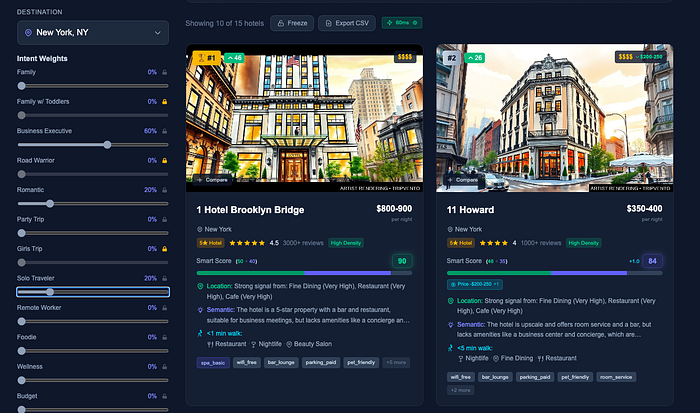
Tripvento’s ranking demo — hotels scored by traveler intent, not just stars and price.
The 14 personas aren’t arbitrary buckets I made up over a weekend. They come from analyzing how people actually describe what they want from a trip — romantic, business, family, adventure, party, wellness, budget, luxury, solo, cultural, foodie, nature, accessibility, digital nomad. Each one has its own weighted scoring model.
Why this matters now
Two things are converging that make this the right time.
First, AI agents are becoming the front door for travel planning. People are asking ChatGPT and Perplexity where to stay. Those models need structured, intent-aware data to give good answers — not just a list of hotels sorted by price. Tripvento gives them that.
Second, corporate travel platforms are under pressure to personalize. The days of “here are three approved hotels near the office” are ending. Travel managers want to offer options that actually match what their employees prefer while staying within policy. That requires a ranking layer that understands traveler intent, and right now, most platforms don’t have one.
Where I’m at
I’m scaling city by city. The technical infrastructure is built and working. Right now I’m focused on expanding coverage and getting the product in front of the right partners — OTAs, corporate travel platforms, and AI agent developers who need better hotel data.
I’m also a Head Teaching Assistant at Georgia Tech, where I help run the Graduate Operating Systems course for over 1,000 students. I mention that because people sometimes ask how I think about building systems, and the answer is that I’ve spent years teaching other people how they work at the lowest level. That shapes how I architect things.
If you’re building something in the travel space — or you’re just frustrated with how hotel recommendations work — I’d love to hear from you. I’m writing here to share what I’m learning along the way: the technical decisions, the market dynamics, and the stuff that goes wrong.
Because plenty of stuff goes wrong. That’s the part nobody writes about, and it’s usually the most useful part.
Ioan Istrate is the founder of Tripvento (tripvento.com), a B2B travel API that ranks hotels using geospatial intelligence and semantic AI. If you have an interest in travel tech let's connect on Linkedin.


